

Brand as a Human – Using Archetypes
A brand, like a human, must answer fundamental questions during the process of shaping its identity: Who am I? Where am I? Why do I exist, and for whom? One of the tools that can be used to shape brand identity, define its traits, and communicate its essence to the audience is archetypes. But what exactly are they, what can they do, and how can they be used wisely?
What are brand archetypes?
In 1919, Carl Gustav Jung introduced the concept of the archetype (from Greek arche – beginning, topos – type/pattern), claiming that archetypes represent behavioral patterns that define different ways of being. They are universal personality patterns composed of a set of traits characteristic of each archetype. These traits help us recognize which archetype we are dealing with. We observe them in people, but they can also be applied to brands.
When defining a brand, it is essential to reflect on: Who is the brand? What personality do we want it to have? Which traits should it embody? Which values will it represent, and what is its mission?
Why use archetypes in branding?
Jung’s theory of universal patterns in our unconscious inspired Margaret Mark and Carol S. Pearson (in The Hero and the Outlaw: Building Extraordinary Brands Through the Power of Archetypes). They argued that brands without strong identity often compete only on price—a strategy that leads to constant cost-cutting and long-term instability. A strong brand with consistent communication is the solution, and archetypes are a tool to help achieve this.
How archetypes work
According to Mark and Pearson, people navigate two axes when seeking their place:
-
Independence and self-realization vs. belonging to a group
-
Stability and control vs. risk-taking and mastery
Once a brand has clearly defined what it wants to communicate and which customer needs it addresses, it’s time to choose an archetype. Archetypes help align the brand’s personality with audience expectations and market demands.
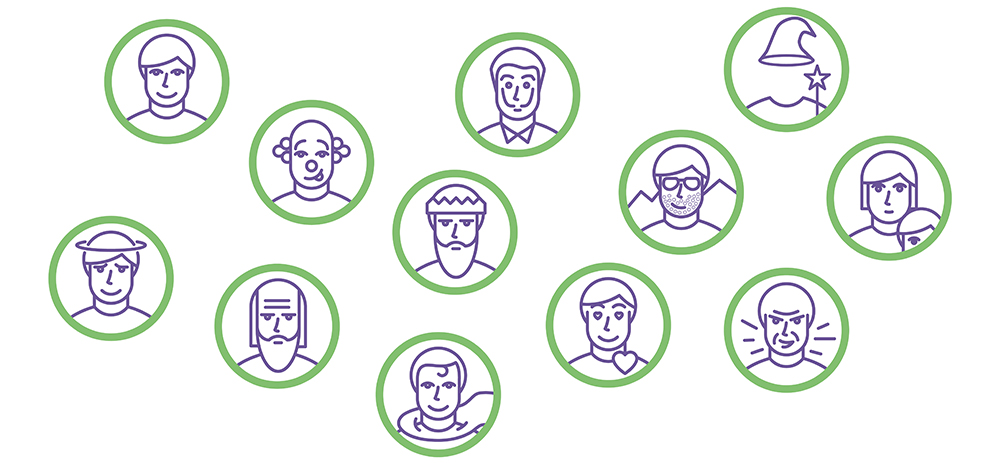
The 12 archetypes by Margaret Mark and Carol S. Pearson
-
Creator: An artistic soul endowed with numerous talents. A visionary with great imagination and innovation, who believes they can create something exceptional and timeless. The Creator likes to stand out and is far from blending into the crowd.
-
Ruler: Values control and feels responsible for ensuring the safety of those under their care. Guarantees stability, prosperity, and well-being. Actions are constructive, thoughtful, and well-organized. The Ruler is realistic, avoids extremes, and maintains order.
-
Caregiver: Gives and nurtures. Finds purpose in helping others and providing what is essential for life. Feels responsible for others and dedicates themselves to their well-being. Intentions are sincere, and actions protect or assist others.
-
Everyman: Does not stand out from the crowd but charms with ordinariness. Grounded and down-to-earth, values belonging to a group. Acts as a quiet, discreet helper, accompanying others in everyday life.
-
Jester: Puts freedom, fun, and joy first. Optimistic, carefree, and enthusiastic, with a sense of humor. Views the world as a source of pleasure and play, exploring it intuitively. Often communicates through jokes and playful interactions.
-
Lover: Passionate and engaged, guided by the heart. Romantic, sensual, and sensitive to aesthetics. Skilled at appealing to the senses in a refined way. Strives for pleasure and blissful experiences.
-
Hero: Focused on achievement and success. Courageous, taking on challenges that are often risky and difficult to accomplish.
-
Outlaw: Challenges authority and breaks rules. Strives for revolution to dismantle systems that no longer function properly. Deconstructs old beliefs or structures to reach a higher level of development.
-
Magician: Seeks to make dreams a reality, creating magical and transformative experiences. Possesses knowledge, skills, and power to change and heal reality. A spiritual visionary.
-
Innocent: Faithful, trusting, and pure, with a positive outlook. Desires paradise and approaches life with optimism and hope. Values safety and predictability over change and discovery.
-
Explorer: Seeks a better, more authentic world and life. Values authenticity and individuality. Wants to experience novelty and experiment, exploring the unknown.
-
Sage: Uses intelligence and wisdom to better understand the world and help others understand it. Acts as a mentor and advisor. Investigates reality, asks questions, and seeks insight.
Archetypes as a guide in discovering and strengthening the meaning of a brand

Each of the archetypes described above has specific traits and a distinct personality. The chosen archetype thus allows for a clear and complete description of the brand’s personality, as well as the creation of a list of traits to be communicated to the audience. Each archetype carries its own unique language, style of action, and mode of expression. Consistency in applying them helps build a coherent brand image. As a result, the audience will know what to expect when interacting with the brand. The theory of archetypes, therefore, serves as a kind of guide for discovering and strengthening the meaning of the brand.